
HACCP: Preventing Food Safety Problems
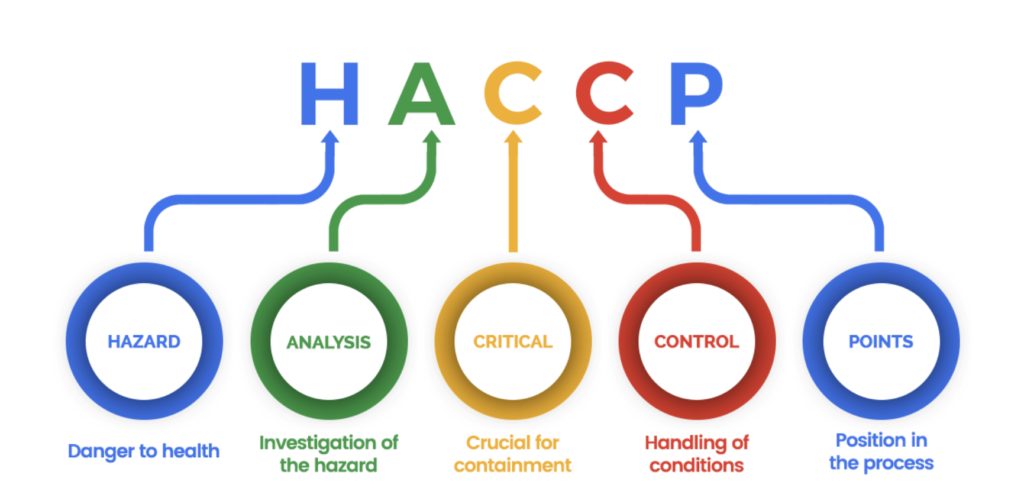
HACCP stands for Hazard Analysis and Critical Control Point. It is a food safety system used by restaurants, cafeterias, and food businesses to identify possible hazards and prevent problems before food reaches the customer.
Food moves through several steps during preparation, such as:
Receive → Store → Prepare → Cook → Hold → Serve
At each step, HACCP asks: What could go wrong, and how can it be controlled?
Types of Food Safety Hazards
HACCP focuses on three main types of hazards:
- Biological hazards: harmful bacteria, viruses, parasites, and other microorganisms.
Example: Salmonella in raw chicken. - Chemical hazards: harmful chemicals that may contaminate food.
Example: sanitizer accidentally sprayed near uncovered food. - Physical hazards: foreign objects that accidentally get into food.
Example: broken glass or metal pieces in food.
The 7 HACCP Principles

1. Conduct a Hazard Analysis
Identify possible hazards that could occur during food production.
2. Determine Critical Control Points (CCPs)
A Critical Control Point is a step where a food safety hazard can be prevented, eliminated, or reduced to a safe level.
For example, cooking may be a CCP because proper cooking can destroy harmful bacteria.
3. Establish Critical Limits
A critical limit is a measurable safety requirement that must be met at a CCP.
Critical limits may involve:
- temperature
- time
- pH
- another measurable condition
4. Establish Monitoring Procedures
Employees must check whether the critical limit is being met.
Examples include:
- checking food temperatures
- checking refrigerator temperatures
- recording information on a log
5. Establish Corrective Actions
A corrective action is what employees do when a critical limit is not met.
For example, if chicken has not reached the required cooking temperature, it should not be served yet. The employee may need to continue cooking it and check the temperature again.
6. Establish Verification Procedures
Verification means checking that the HACCP plan is working correctly.
A manager may:
- review temperature logs
- observe employees
- check thermometer accuracy
- review corrective actions
7. Establish Record-Keeping Procedures
Food businesses keep records to show that the HACCP plan is being followed.
Records may include:
- cooking temperature logs
- refrigerator temperature logs
- corrective-action reports
- thermometer checks

HACCP in Action
Imagine a school café is preparing grilled chicken sandwiches.
The café identifies harmful bacteria in raw chicken as a biological hazard. The team decides that cooking is a Critical Control Point because proper cooking can control the hazard.
A safe cooking requirement is established as the critical limit. Employees use a food thermometer to monitor the chicken.
If the chicken does not meet the critical limit, employees take a corrective action, such as continuing to cook it and checking the temperature again.
A manager later reviews the temperature logs and checks that employees are following the procedures. This is verification. The café also keeps the temperature logs as part of its record-keeping.
The goal of HACCP is to identify hazards, control risks, and prevent food safety problems before they cause illness.
